About the Climate Biennial

Climate Biennale: art, industry and territory
The Climate Biennial is a meeting space open to citizens. In addition to being a cultural event with an extensive exhibition programme, the biennial is conceived as a place for meeting and debating.
Here, the word “climate" goes beyond atmospheric weather. It also refers to the social climate in which we live, to how we live together, work and interact.
From this broad perspective, the biennial brings together diverse people and organizations to reflect, through art, culture and landscape, on issues that affect us all, such as employment in the future, the relationship between rural and urban or democratic coexistence.
Driving organizations
The Climate Biennial: art, industry and territory was created as the result of an inter-institutional alliance integrated by the Ministry for Ecological Transition and Demographic Challenge (MITECO by its acronym in Spanish), the Ministry of Culture, the Ministry of Housing and Urban Agenda, the Principality of Asturias, the City Council of Avilés and the Atelier itd Foundation. It also has the support of the Daniel and Nina Carasso Foundation and of the Community Arts Lab by Porticus.
.png?w=360&q=85&fit=max&auto=format)




Features of the Biennial

There are three features that define the spirit of the Climate Biennial:

Amanda Piña, Florecimiento. 2024
Due to its ability to foster reconciliation and debate under in a serene and creative environment. This is expressed through its exhibition programme and its public programme.
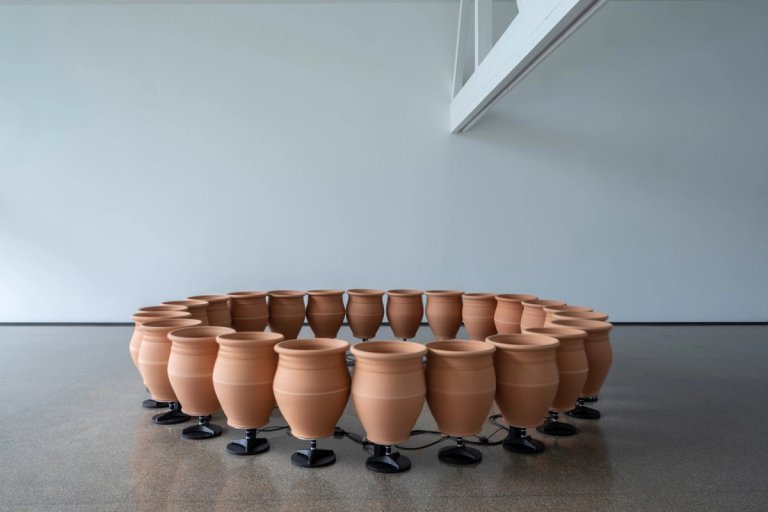
Abelardo Gil-Fournier, Hacendera. 2023. Fotografía de Juan Baraja
Due to its promoters and origin. Institutional promotion comes from public administrations with the support of several foundations. Industrial companies and social organizations also participate in the public programme.
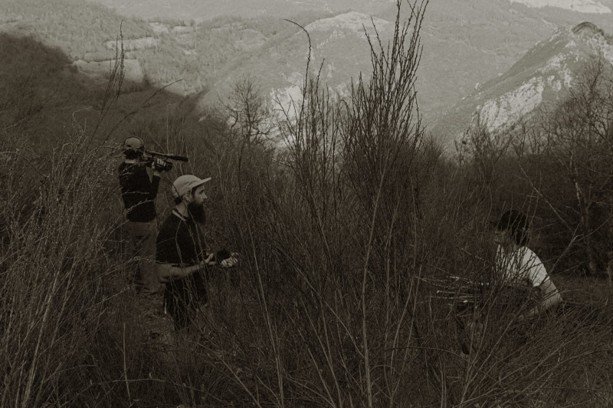
ÁlexGalán, La cabaña que quería ser bosque. Rodaje, 2026
Due to being inspired by the deep study of the territory. Local artists and creators participate in the biennial. In the debates that will take place there, Avilés will be an example and a metaphor of transformations and challenges of our society.
Exhibition program
The Climate Biennial presents an exhibition model that activates spaces emblematic to the territory and engages with their histories, uses and present-day communities. Transcending conventional museum formats, the exhibitions are distributed across distinctive architectures and infrastructures, inviting us to think through the eco-social transformations of our time.
Public program
The Climate Biennial public programme fosters spaces for conversation, deliberation and attentive listening, inspired by the participating works and artists. It proposes imagining future possibilities, encouraging dialogue between diverse perspectives, and trying out participatory formats that favour coexistence amid disagreement, moving away from polarisation and promoting a shared civic space.
Investigation
The Climate Biennial is not intended solely as an exhibition event, but as a research, production and transformation process sustained over time. Beyond the biennial temporary nature, it promotes programmes and lines of work that allow for the development of lasting forms of collaboration between art, architecture, science, institutions and the citizenry. These initiatives open up questions about what remains before and after a biennial, how the works are produced and what types of legacy —material, institutional, social or territorial— a cultural project can activate in the context of the eco-social transition.
State Collection of Art and Climate
Promoted by the Ministry for Ecological Transition and Demographic Challenge (MITECO), the National Art and Climate Collection is the heart of the Climate Biennial. It originated thanks to the collaboration between the MITECO and the Ministry of Culture, and is part of the 2% Cultural programme —a public initiative that allocates part of the Nation's investment to protect and enrich the historical, artistic and cultural heritage in Spain. Each edition and curatorial proposal of the Climate Biennial contributes to building the collection and, at the same time, the collection guides and gives meaning to the exhibitions in an ongoing dialogue. Heritage is understood thus as a living reality, in constant transformation and linked to current eco-social challenges.
ACTS Residences
The ACTS (Art, Science, Technology and Society) residency programme opens a space for interdisciplinary research and collaboration to address the complexity of the ecological transition from the intersection of artistic practice, scientific knowledge, technology and public institutions. Through these programmes, the Climate Biennial promotes work contexts where artists, researchers, technical staff and institutional agents share processes, methodologies and infrastructures, exploring new forms to understand and narrate eco-social changes. Conducted jointly with organizations such as the National Meteorological Agency (AEMET), the City of Energy Foundation (CIUDEN) or the Cultural Factory of Avilés, the residencies are articulated around areas such as meteorology, energy transition or industrial and digital transformations. These research processes culminate in new production works which, in some cases, become part of the MITECO National Art and Climate Collection.
Common Architectures
a line of research within the Climate Biennial that explores how public spaces and facilities can become places for learning, coexistence and adaptation in the face of the eco-social emergency. The proposal stems from the notion that libraries, parks, markets or community centres can play a fundamental role in the construction of new forms of relationship between the citizenry, institutions and the territory. Public facilities are thus understood not as service spaces, but as living ecosystems where art, architecture and diverse knowledges are intertwined to try out other ways of living. Through situated research and experimentation processes, this line seeks to activate these spaces as social and environmental infrastructures capable of responding to present-day challenges.
Activities and exhibitions in dialogue
The Climate Biennial also enters into dialogue with activities, exhibitions and projects conducted independently by institutions, spaces and cultural agents that wish to join this framework for reflection and collective action. Through these collaborations, the Biennial expands its scope and fosters a network of initiatives connected by shared eco-social concerns.