Sustainability as a Cultural Practice: A Shared Narrative for the Climate Biennial with Renfe, Smart&City, Bosquia and Factoría Cultural
The Climate Biennial: Art, Industry and Territory is rooted in a conviction: the ecological transition does not depend solely on new technologies, better regulations or scientific advances. It also requires transforming the imaginaries through which we understand our relationship with territory, resources and the ways in which we inhabit the planet. Culture plays a central role in this challenge because it can generate new narratives, spark conversations and explore possible futures.
Under the motto Rehearsing the Unexpected, the Biennial understands culture as a space for experimentation where art, science, industry, institutions and citizens come together to explore new ways of addressing the climate crisis. In this context, sustainability is not a parallel line of work, but rather the principle guiding the project’s planning, production, mobility, governance and legacy.
This approach means understanding sustainability beyond reducing environmental impacts. It means designing processes capable of generating shared value for the territory, fostering new alliances between public and private actors, promoting responsible production models and leaving behind capacities that remain once the Biennial has come to an end. In other words, it means turning a cultural event into a laboratory for exploring how the ecological transition can take shape through cultural practice.
The following presents a shared narrative based on the collaborations developed with RENFE, Bosquia, Smart&City and Factoría Cultural as part of the Climate Biennial.
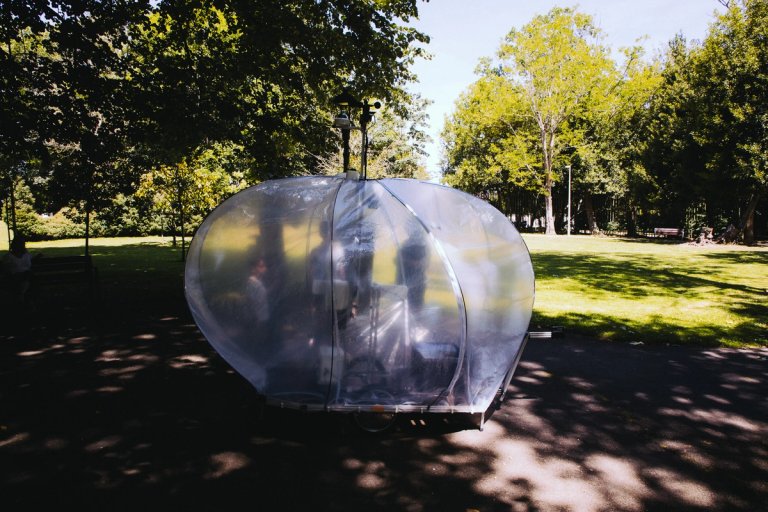
Nube móvil de Rotor Studio - ©Nico Rodríguez
A Comprehensive Sustainability Model
The Biennial’s sustainability strategy is structured around five principles:
- Understanding sustainability from a systemic perspective, considering environmental, social, cultural and territorial impacts together.
- Prioritising co-benefits, assessing how each action can generate simultaneous positive effects across different areas.
- Fostering collaboration between public administrations, businesses, cultural organisations, the scientific community and citizens.
- Embracing open-ended processes of learning and continuous improvement based on evaluation.
- Using culture as a catalyst to accelerate the ecological transition and strengthen territorial resilience.
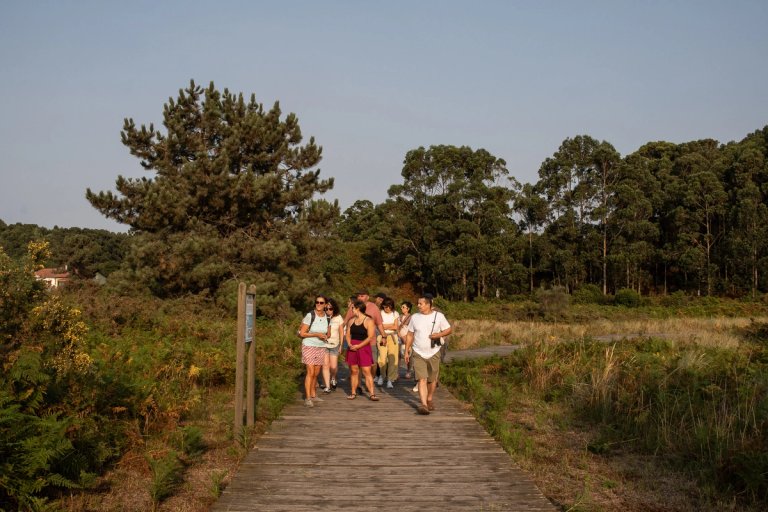
Rutas Ornitologíay Biodiversidad con MAVEA - ©Nico Rodríguez
Key Sustainability Actions Implemented
Throughout the organisation of the Biennial, numerous measures have been implemented to reduce impacts and enhance the project’s environmental and social value. The Climate Biennial has integrated sustainability criteria into every stage of the project’s planning, production and development. Beyond reducing environmental impacts, these actions seek to demonstrate that it is possible to promote a cultural production model capable of generating environmental, social and territorial value. Key measures include:
Governance and Evaluation
- Designing a comprehensive sustainability strategy from the initial planning stages of the Biennial.
- Identifying and communicating the environmental, social, cultural and territorial co-benefits generated by the project.
- Collaborating with Smart&City, Bosquia and Renfe on the analysis and evaluation of sustainability indicators.
Responsible Production
- Prioritising the use of existing public facilities and cultural infrastructures, as well as the reuse of urban and industrial spaces, avoiding new temporary constructions.
- Exhibition design focused on the reuse, modularity and second life of materials, in collaboration with La Factoría Cultural.
- Eliminating the use of plastics and vinyl in exhibition texts, replacing them with lower-impact solutions such as recycled cardboard.
- Using recycled paper and cardboard for wall texts, room sheets, guides and other mediation materials.
- Designing room sheets as collectible items, encouraging their preservation and reducing the overproduction of printed materials.
- Incorporating environmental criteria into graphic and editorial production, as well as across communication materials, based on the guidelines shared by the Ministry for the Ecological Transition.
Sustainable Mobility
- Territorial planning of the programme to encourage walking between the Biennial’s different venues.
- Promoting low-emission mobility through the collaboration with RENFE as the Train of Culture, encouraging visitors to travel to the event by rail.
Circular Economy and Social Impact
- Prioritising local companies and suppliers in the production and delivery of the Biennial, reducing travel and logistical requirements while ensuring that part of the economic value generated by the project remains in the territory.
- Responsible production of official merchandise, limiting manufacturing to the actual needs of the Opening Days (11–13 June 2026) to avoid overproduction and material waste.
- Developing uniforms for the mediation team through the reuse of industrial textiles from ArcelorMittal, in collaboration with community organisations in the territory, integrating circular economy and social inclusion criteria facilitated by La Factoría Cultural.
Legacy and Cultural Transformation
- Collaboration with Bosquia to develop ecological restoration initiatives and generate positive environmental impact through tree planting in Avilés.
- Integrating sustainability as a cross-cutting principle across the artistic programme, public activities and cultural mediation.
- Building a collaborative model that brings together public administrations, businesses, universities, cultural institutions and social organisations to promote the ecological transition through culture.
- Developing a strategy focused on leaving lasting capacities, learnings and partnerships that extend beyond the duration of the Biennial.
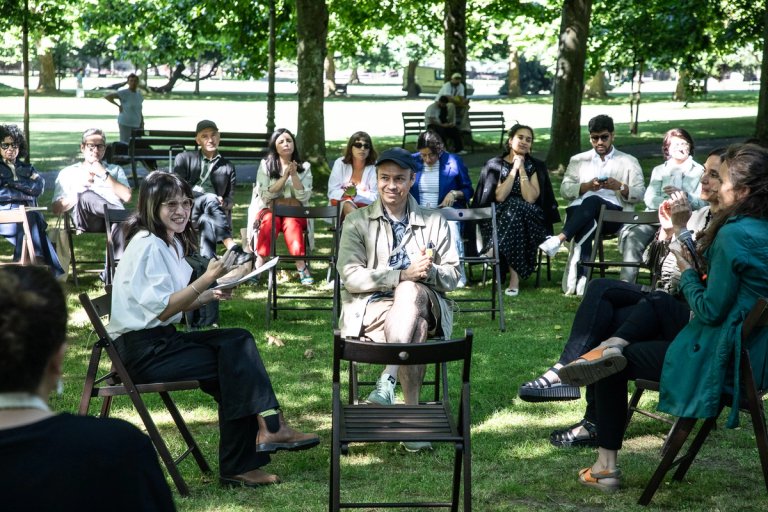
¿Qué significa Ensayar lo inesperado en un mundo que no entendemos? - ©Nico Rodríguez
What the Rehearsal Leaves Behind
It leaves behind the capacity to learn from what has been done. The collaboration with Smart&City enables the Climate Biennial to have an evaluation methodology and a set of indicators to measure its environmental, social, cultural and territorial impacts. Beyond evaluating this first edition, the aim is to generate knowledge and recommendations that can help make future editions increasingly sustainable, turning evaluation into a tool for continuous improvement.
It leaves behind new ways of inhabiting and moving through the territory. Thanks to the collaboration with RENFE, the Climate Biennial has promoted rail travel as a lower-impact way of accessing culture, strengthening the connection between sustainable mobility and ecological transition. Beyond facilitating travel for artists, participants and visitors, this partnership demonstrates that decarbonising culture is also shaped by everyday decisions about how we move around.
It leaves behind an active community, new alliances, shared learnings and a tangible legacy. After 100 days of programming, more than 40 artists and collectives and more than 60 activities, the collaboration with Bosquia will allow this legacy to continue growing through the planting of 100 new trees in Avilés. This ecological restoration initiative turns the end of the Biennial into the beginning of a new process for the territory.
It also leaves behind materials that continue to tell new stories. In collaboration with Factoría Cultural, the Climate Biennial has incorporated circular economy principles into its production processes, giving industrial textiles from ArcelorMittal a second life by transforming them into uniforms for the mediation team, together with community organisations in the territory. In addition, all exhibition elements — signage, room texts, panels and other supports — have been designed to be recovered and reused once the Biennial comes to an end. A way of demonstrating that sustainability does not end when an exhibition closes; it begins when materials are designed with their next use in mind.

Refugios climáticos. Bienal Climática 2026. Créditos: Paula Díaz